Monday, 17 October 2016

Don't count people - make people count

I recently gave a talk at an event called Inclusive Workplaces, focusing on how SMEs can embed E&D into their business. I was a late substitute for a speaker who is an E&D specialist, and my talk built on what she was going to cover whilst looking at E&D from an HR perspective. The talk was well received and I've put the main points down here.

I worked in an organisation that really "got" E&D and inclusivity (I'll use the phrase E&D to refer to a broad spectrum of terms like inclusion etc) and on reflecting on this experience for the recent talk, I looked at what worked in that organisation and what I'd recommend if you are looking at how to embed E&D in your organisation.


In general though my view is that E&D is about having an amazing workplace - the two go hand in hand - and if you focus the right way on engagement then you'll get E&D, and vice versa.  But here's my building blocks:
  • Commitment from the very top - we had a CEO and a Board who understood and were passionate about E&D, and kept it at the forefront of organisational thinking
  • Someone to co-ordinate and pull everything together - we had one person to centrally manage E&D and keep all the various plates spinning (though this could be a double-edged sword later on)
  • Involving the local community - there were lots of groups related to protected characteristics who were keen to help us develop services and employment
  • External scrutiny and recognition - a plethora of organisations came to inspect us, grade us and recognise our practice, and this made us up our game
  • Collecting and using data - going beyond compliance, we were able to explain regularly why we were collecting data and show examples of how we used it to drive service improvement and staff engagement
  • Managing the supply chain - involving Procurement in creating guidance for our potential and actual suppliers, giving them a step by step approach to adopt our E&D principles, offering free training for their staff if they signed up to our commitments
  • Comms team on board - we had a strong comms team who were bought into the vision and reality of an inclusive workplace, who helped us to promote events, campaigns and could highlight any successes we had
  • Reviewing the employer brand - we did videos promoting inclusive employment practices on the recruitment microsite, case studies promoting positive action initiatives and more - we also made the whole website all singing and all dancing with information available in lots of different ways, media and formats
  • Embedding into performance management - we broke E&D down down by service area with headline objectives for each area and individual objectives for staff that could be measured in appraisals, with a simple list of tasks that any member of staff could do to evidence getting involved in E&D activity
  • Taking on public duties - we became a Hate Crime reporting centre (when we didn't need to) and this helped our public image aswell as bringing this important area to the fore
  • Leading the community - we organised community events to celebrate diversity - this helped us set up support groups for both customers and staff linked to protected characteristics
Ultimately we made E&D about helping our customers, and not about looking at protected characteristics - it was our ethos, our culture and our values - and it wasn't something separate or different.

But there were drawbacks, as I noted in my talk:
  • Relying too much on one person - we had an excellent person to co-ordinate it with a great deal of knowledge and enthusiasm aswell as a strong network of contacts - but when this person left, we found we couldn't get anyone to replicate this and the momentum was lost
  • Allowing one PC to dominate to the exclusion of others - the strength of some community groups focused on the BME community compared to some other groups linked to other protected characteristics allowed them to dominate the agenda somewhat, out of proportion
  • Pressuring staff to get involved just because they have a particular PC - we tried setting up a staff LGB group that contained the 3 LGB staff that we knew about - and not all of these were keen to be involved.  Sometimes we'd ask their opinion just because they were LGB, and that wasn't helpful
  • Taking a sledgehammer to crack a nut - we ran some Trans awareness campaigns that were really powerful and illuminating, but we had no Trans staff or applicants and only a tiny % of Trans customers, so the vast majority of staff didn't get a chance to utilise their new knowledge
  • Other organisations don't always share your enthusiasm - be careful if you work closely with another organisation in that this organisation may not have the same approach to E&D as you do, and if you end up merging with an organisation there may be real differences to explore and one of the organisations will need to radically change its approach, which may be painful
So we had an Inclusive Workplace, with lots of things that worked, and some lessons that I learnt along the way.  I'd sum up my thinking on inclusivity as follows:
  • Have targets but don't let these get in the way of doing the right thing.  Use your E&D targets to evidence improvement and traction, rather than a stick to beat yourself with.
  • Let staff get involved in decision-making and tailoring the organisational approach to E&D - celebrate any successes and make E&D as fun and informal as possible
  • Dare to be different in your training - do drama-based workshops, and workshops on unconscious bias to help people understand the way they think
  • Break down your available data on both staff and customers by protected characteristic and look for any trends - work to redress negative ones
  • Allow people to voice any concerns they may have and have adult-adult conversations about E&D.  But if there are any instances of inappropriate behaviour - act upon and challenge these straight away.

I also think its true that you reap what you sow at work, in every sense.  If you're willing to put in the effort and energy to make your workplace amazing and inclusive, you'll achieve it.  If you're not, well, you won't, and it won't be as happy a place.

If you're going to have an inclusive workplace, focus on enriching the employee experience and make it an amazing place to work...

...So don't count people - make people count.

Friday, 7 October 2016

Carpool Karaoke

I've recently had a few conversations about mental resilience and wellbeing in the workplace.  I've reflected on what I do when I have a difficult day or set of circumstances to deal with at work.

We all have bad days.  In HR we probably have more than our fair share because at least part of what we do is helping others to deal with the bad days they are having, and some of that is bound to rub off emotionally.

Some people will deal with this better than others.  In wellbeing and HR circles this is often referred to as resilience, or mental toughness.

I'm not sure it is that, but what I do think happens is that those people have found outlets for their emotion and ways of processing it.  If that's resilience then OK, but to me resilience is something internal around personality, whereas I think what I'm describing is more outward facing around behaviour.

I've written a lot about my approach to personal fitness and how that has helped me in the past, and that's the kind of stuff I mean - just having some way of processing what you've been dealing with.  It doesn't have to be physical activity, as long as it works.

I also think having something of a support network matters too, not just at home where one would expect to have it, but at and in the workplace amongst your peers.

What do I mean?

Well, if you're without friends and people you can talk openly and honestly to in the workplace, you will struggle to process some of the emotion you are faced with there.  Everyone, no matter what their role, needs someone to whom they can talk and have a bit of a rant or moan to now and again, someone who will keep these discussions private and who will both support and challenge.

I noticed this when I moved jobs earlier this year - all of a sudden my support network at work was gone, that I'd spent 12 years building up, and I had to start all over again.  I found this very difficult, and it took 4 - 5 months before I had even the beginnings of a support network again and had that outlet.  But once I did, I immediately noticed a difference in how engaged I felt and how motivated I was.

Perhaps the best example of a support network I've ever had was a fellow senior leader at my last place of work, who car shared with me for over 10 years.  Spending 1.5 - 2 hours a day together in a confined space, 4/5 days a week for 10 years - you become close, you end up telling each other almost everything and you come to rely very much on that person as a source of support and guidance.

Most journeys home from work were each of us telling the other what we'd done that day and, on the occasions where we'd interacted in the workplace, discussing how those things had gone - discussing our views on other people's behaviour, our own behaviours, our view of the organisation and its direction, and almost everything to do with what was causing us to feel emotion at work.  We coached each other, challenged each other, argued occasionally but always felt much better at the end of the journey.  This helped me to download my emotion and get home able to focus on what was important there, without having to bore people at home with it all or being distracted by thoughts of home.

Nowadays I drive solo to work, but I still, almost a year since the car sharing ended, find myself talking out loud in the car to my no-longer-there car sharer friend and imagining his responses.  I have, once or twice, been on autopilot on my commute and realised I was headed to his house to collect him, before remembering we work in different towns now.

I watch James Corden's Carpool Karaoke videos and think these are an excellent example of people going to/from work having fun and sharing emotions, and usually arriving at work in a better state.

In my own carpool, we never did karaoke - neither of us could sing at all - but we gave each other a boost by just being there.  We were confidants for each other, and that's something that's hard to replace but if you can get it in the workplace, will be enormously helpful.

Until I find it again, I've still got my physical exercise regime.

What's your Carpool Karaoke?  How do you deal with a set of difficult circumstances at work and process the emotion so that you're able to focus on home life when you get back?

Till next time...

Gary

PS we think our next family holiday may be our last as a 5-piece family, as eldest son may be too old and too cool to come with us after next year. So we are thinking of stretching ourselves and doing a fortnight in Florida...

Saturday, 1 October 2016

Back to school

So I'm studying to become a qualified Personal Trainer. This blog post will explain why, what's involved and how I see links with fitness training and other areas of my work.

I've long had an interest in fitness, but particularly in the last 7 or 8 years or so. My interests started on a very personal level as a quest for fitness and a changed image (both physically and mentally) of myself became part of how I reinvented myself after a difficult divorce, giving me motivation and fuel to become someone different, and better. I developed this into doing random endurance challenges to give focus to my fitness training, and learnt more about what fitness was and how to train. I've then developed this into racing in triathlons and from there fitness training has become a valued and indispensable part of my life.

I also have a professional interest in it. As a senior HR figure in several organisations I have had overall responsibility for health and wellbeing, and on occasion full blown health and safety too. I understand the links between physical and mental wellbeing, employee engagement, productivity and performance, and know that there is significant evidence to suggest that a fit and healthy employee (in every sense) will out perform one who is unfit and unhealthy. So I push these things at work too.

And I'm doing the qualifications to further my own knowledge and seek recognition or accreditation for the knowledge I already have. They are likely to help me improve my own training, and help me improve the health and wellbeing programmes I oversee in work.

I'm lucky enough to work for a qualifications provider so I can get easy access to the qualifications, and feel fortunate in this regard as access hasn't been easy in previous roles despite my enquiring!

I've blogged on the HRDirector magazine site HERE about employee wellbeing and how organisations need to be more proactive in promoting it. So I'm following my own advice. .

I've blogged also on Gem Dale's fitness blog HERE about my own approach to wellbeing and the backstory to why I'm interested in fitness. So here's the next chapter. 

There are actually two qualifications I'm completing, one after the other. The first is a Fitness Instructor qualification that in theory would allow me to run exercise classes in a gym. I'm mad keen to run my own spin class for anyone who will turn up and that looms large as a possibility now. The second is the conversion to Personal Trainer status and that would allow me to work individually with anyone wishing to improve their fitness. I'm looking forward to doing that too.

Professionally the qualifications will help me with my understanding of approaches to wellbeing in the workplace and particularly how individuals may benefit from a more tailored approach to wellbeing. They should help me to analyse organisational data on wellbeing and absence (etc) and suggest more appropriate and effective solutions.

They also should help me to coach leaders, something I do regularly anyway, but enabling me to offer a different dimension to looking at performance issues and their resilience etc. This is something Sukh Pabial blogged about very well HERE too. 

Of course, my blog is called The Power of Three and in the About Me page I talk a little bit about this holistic approach to individual development and performance coaching. So in essence all I'm doing is putting this into practice.

Speaking of practice, I'll need people to practice on when I'm doing the Personal Trainer part of it, so if you're interested in being a case study / guinea pig, let me know.

I promise I'll be as mean as you need me to be.

Which is only a little bit meaner than you want me to be.

Don't get me wrong, I'm not looking to change professions and become a full time personal trainer. But I wouldn't mind helping friends, family and colleagues in my spare time to become even better at health and fitness.

I'm hoping I'll be rather good at it.

I'll keep you posted on my studies.

Till next time.

Gary

PS in other news, we are already looking at 2017 holidays and it may be our final one as a whole family before at least one child gets too old (and too cool) to come with us. Now that makes me feel old…

Friday, 23 September 2016

Here we go again

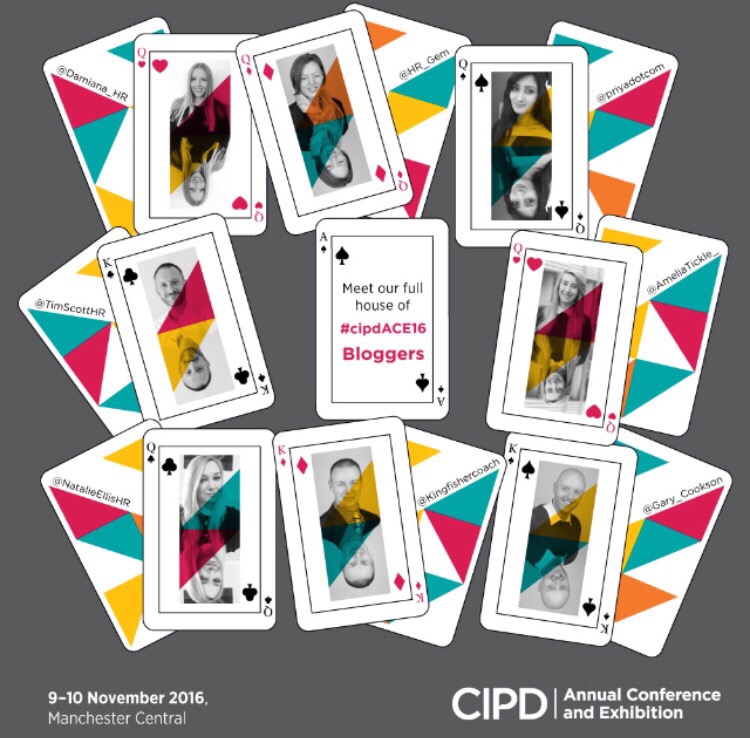
So I'm going to the Ball...again. And by Ball I mean as part of the Blogsquad for #CIPDACE16 - the annual conference, exhibition and gathering of HR, OD and L&D professionals.

This is very exciting news for me, although I fully accept you may not be quite as excited.

Here's the full Blogsquad, with a "full house" theme this year which I'm sure I can pun my way through.

I was part of the Blogsquad last year, which I wrote about afterwards HERE.  But to be invited back again this year is tremendously exciting as well as ego-boosting - I enjoyed myself so much and felt I contributed a lot last year, and am looking forward to doing the same again this year.

Although the experience of being in the Blogsquad was exceptionally tiring, the positives far outweighed the negatives.  The Conference, the learning from it and the discussions I had with people about it and lots of other things were amazing.

And I love the CIPD Annual Conference.  I haven't missed a year since I first went in 2004, although I do still miss the small town feel that Harrogate had when the Conference more or less took over the town and in every hotel and bar you could find something going on that was HR-related.  But last year Manchester finally came into its own with a top notch programme and set of fringe and social activities (although all the ones I wanted to go to happened on the same evening, which was unfortunate).  As a Conference though you just can't beat it for sheer value and learning potential, even if - like me in years gone by and plenty of others - you just go to the exhibition and free seminars - nothing wrong with that at all and in fact you end up winning just because of the free stuff and learning you pick up.

A few days ago I asked, via social media, why other people go to the Annual Conference.  This is a selection of the quotes I got back, which perfectly illustrate the different reasons people go to the Conference and the different things they get out of it.

David D'Souza: "It has become an unwritten tradition that I'll find a way to humiliate myself, somehow, with the keynote speaker. So there was the awkward moment with Rita Gunther McGrath when I was introduced as 'the guy you've been tweeting about bubble wrap' just before she took the stage and the time I got star struck and asked Daniel Pink if I could move in with him. Both memorable, for different reasons."

Michelle Parry-Slater: "My stand out CIPD ACE moment was Peter Cheese and his "let them get on with their job, next question" statement when asked what he would do if an employee came to work with blue hair and tattoos #LoveIt"

Helen Amery: "My favourite memory is ACE 2013 when I was at the turning point in my career and I met so many great people from Twitter in real life for the first time. A whole new world was opening up to me and it was great to get out and discover more of it"

Mike Morrison: "For me its always the people."

Amy Humphreys: "I go for the atmosphere, the lovely people I get to hang with, and of course there's so much learning to be had!"

Darren Vann: "Going for the first time myself, was really just looking forward to the whole experience but now I'm keen to make sure I don't miss David D'Souza humiliate himself."

I understand what each person gets out of going.  Its the whole experience, and each year its different.  One year I got chatted up, and asked out for dinner, by a CIPD researcher whilst browsing books on their stand.  Another year I totally gatecrashed a fairly posh employment law networking event to which I wasn't invited, ate lots of food, had a drink and then made a dash for it.  Another year I came home LOADED with free gifts for my children and having won a £500 Red Letter Days voucher and some champagne.  EVERY year I make the most of the exhibition, talking to suppliers about what they're doing and how it interests me, catching up with people I've not seen for ages, attending the free seminars, and in recent years I've attended the full conference and got access to the premium content too.

This year's programme looks great, which you can view HERE.  There's so much to choose from and I feel like I want to be in 2 or 3 places at once.  Peter Cheese's introduction always contains a couple of soundbites that sustain many for an entire year, but the keynote speeches are different enough to offer lots of good insight.

The introduction of five different streams and five different types of session gives some structure but to be honest I don't think this was needed as the sessions kind of sell themselves without having the labels around them.  There's some good sessions available this year on what I think is the right range of topics.

The list of free seminars is also impressive and I'll genuinely struggle to decide where I need to be.

I'll be in and around the Conference for its entirety so if you see me wandering around the exhibition or sat in a conference session, please come and say hello.  Aswell as blogging about the content I'll be trying to capture people's views and reactions to the whole thing, so if you fancy appearing in print or on video - here's your chance.

And once again I'll repeat my promise from last year, that if any exhibitors have free neck/shoulder massages available on their stands (or even if they don't but its part of their sales technique) then I will visit and talk to you.  I'm that shallow.

Maybe you could even play Blogsquad Bingo and see if you can tick off the full house of bloggers if you manage to spot us all...

And it always feels like the start of Xmas when the Annual Conference gets underway, often because the Xmas Markets are being built just a few hundred yards away in Manchester.  Roll on November.

Till next time...

Gary

PS In other news, honeymoon has been and gone - astonishingly beautiful (but expensive) place, Norway - and I've decided I'd really REALLY like to live there.

Sunday, 4 September 2016

Swipe left, swipe right

In many of my previous posts I've compared the employment relationship to actual relationships and have promised many times to blog in more detail about my comparisons, in particular the ways in which employees fall in and out of love with organisations.

Here's that post.

It obviously has some resonance for me at the moment as I very recently got married. This means I've been reflecting at length on the subject of love, affection, and what it means to be engaged in a relationship both in the marital sense and in the emotional sense.

Now I've had some experience in actual relationships. More than I ever thought I would to be honest. At one point I had a very popular anonymous blog about dating and relationships. So I like to think I know what relationships are about, mostly because I've made loads of mistakes along the way.

But I do think relationships at work are similar to actual relationships, and that the concept of being in love with someone can be equated to employee engagement. After all, accepting an offer of a permanent contract with an employer is as long term as any relationship and in many modern cases, longer.

Hopefully you know what it's like to be in love with someone. You can't wait to spend time with them. You think about them regularly. You find yourself doing nice things for them and seeking praise from them. You talk them up to other people. You enjoy being around them. And there's more besides that, but mainly bedroom stuff and, frankly, this isn't that kind of blog.

But if you're actively and highly engaged with an organisation, it's remarkably similar. You look forward to going to work. You find thoughts about your work passing through your head regularly when you're not there. You find yourself doing nice things for the organisation, commonly known as exerting discretionary effort and going beyond what's expected. You find yourself motivated by good things that happen at work and praise. You talk the organisation up to other people and are an active brand ambassador on social media, regularly promoting its activities and interacting with the brand. And you take part in work social activities and other events.

But what happens when this starts to go wrong?

I've had numerous relationships that have gone wrong. In all cases one party has changed. Sometimes it's so gradual it's not noticeable, other times it can be almost overnight when you wake up one morning and simply don't recognise the person you're next to in bed. I had a marital split that was like that.

And I've had working relationships end in similar ways. I guess everyone leaves a job at some point and if you were 100% happy you'd have stayed. There's something that's made you move on, even if you were largely happy there, it's the small % of unhappiness that has made you move.

Actual relationships are the same. If you are 100% happy you'll not look around for companionship elsewhere or seek another relationship. Often if you're mostly happy you'll stay put too, because it's a big emotional jolt to end a relationship.

And yet, if there's something not quite right, shouldn't you take steps to address that either by putting that right in the relationship or by moving on? Surely you deserve to be happy with someone else than even slightly unhappy?

I've had women end relationships with me using that sentence and it hurts, even though deep down I know they're right.

But does this hold true in working relationships?

If the company culture is strong enough and the line management relationship is similarly strong, then if the employee or employer is slightly unhappy with the other then a conversation will take place and things will happen to make it right again. If these attempts fail, then the employee should be encouraged to move on.

And I say encouraged meaning that there ought to be some kind of inducement or at least support to find another employer. Outplacement and that sort of thing.

But what if the trust has gone completely? What if all the things that attracted you to the employer in the first place and kept you loyal and engaged for, probably, years, have one by one disappeared? What if all the people you trusted and looked to for friendship and support have gone completely or moved to other roles? What if the team you built and shaped and developed are no longer your team? What if everything's different?

In short, what if you don't recognise the employer you're in bed with any more? Can the required conversation even take place? I don't think it can.

It's akin to finding your partner is having an affair. You just don't see it coming but it's devastating when it does.

And here you may start to see the same things happen in both actual and working relationships.

Obviously there will be trust issues presenting themselves. Neither party will wholly trust the other to give 100% of their part of the bargain. There will be a loss of pride in the relationship, in that the employee may no longer feel proud to work for the organisation or to be involved with its work, and may stop telling others who they work for as they may struggle to actually say the employers name. The employee may stop trying, stop giving their discretionary effort and do only the bare minimum to get by. They may, as I've posted about before, become invisible within the organisation and unconnected to it on social media. Presenteeism becomes rife. The employee may get annoyed easily at little things the employer does, and vice versa. And these little things become major issues as neither talks to the other about them. There's a lack of engagement in the relationship, and the spark has gone.

Basically, the employee doesn't recognise the employer any more.

And that's sad. Because it affects how each party views the other. Where once there was love, loyalty and pride, there's now mistrust, fear and antagonism.

And these can build. So how does an employee survive in a loveless relationship?

And I mean loveless in the sense that the love was there once, and is noticed more by its absence as a result. I've been in several relationships where that has happened and inevitably resentment creeps in. It becomes difficult to get through each day in this type of relationship and feelings of wanting to leave the relationship will inevitably dominate. But what should happen here?

In an actual relationship, leaving a long term spouse or partner can be extremely difficult as it may involve separating assets and families. But in the employment relationship it's easier. There's notice to serve but other than that it's a lot simpler. And yet many organisations don't spot unhappy employees or worse don't know what to do with them.

My own view is that if the employee can't become highly engaged again, and is at least not being disruptive or too negative, then the organisation should provide whatever support that employee needs to find a new "partner". When that employee looks back in years to come they will then have fond memories of their parting from that employer, and may come to regret leaving if indeed the grass isn't greener on the other side. They may even come back.

Now this is where working relationships differ greatly from actual ones. If your actual spouse is unhappy then you shouldn't faciiltate them finding a new partner. You don't set up their Tinder account or give them time off to date other people. And if they move on, you don't necessarily want them trying to come back or hassling you with their regret.

But in the employment relationship I think this could work and we could do more to help.


One other similarity is searching for love again after a broken relationship. The first few dates you have are often disasters, while you work off your issues and stop comparing people and things too much. You may become quite cynical about ever finding love again and bounce between relationships, then, when you're not expecting it, BOOM You're in love again.

It may take months, or years. It may be on your first subsequent relationship or your tenth, but if you've been capable of love and being loved again then it will happen again.

There's Plenty of Fish (pun intentional) in the sea, after all.


Of equal importance is the early stages in a relationship when both parties are often assessing the long term suitability of the other. The organisation needs to try as hard as it can to convince the employee to give it 100% of their effort.  If the organisation doesn't try, why should the employee?  In an actual relationship this is very much two-way but in the working relationship I think the onus lies with the employer as part of the settling-in process, and this is where we in HR can really influence things by creating the right culture, coaching line managers on what to do and leading on things like internal communications and L&D.

It's a hard thing when love goes sour in a relationship, but by helping employees to know when to swipe left and when to swipe right, we might heal some broken hearts.  And by making sure organisations do the right thing in the early stages of a new relationship we can help love to blossom.

Here we go again with my "HR as pimps" analogy.

Till next time…

Gary

PS in other news -honeymoon approaches…a Norwegian Fjords cruise!

Monday, 15 August 2016

Wedding Bells

As you might be aware, I get married on 26 August. Here's a blog post about what that means.

Beware, there is very little* HR or leadership or indeed anything professional in this post.

*none

I'm marrying Katie on 26 August at 4.30pm on St.George's Beach in Paphos, Cyprus.  In all likelihood this will be my final blog post before then and for a couple of weeks after (we're back for a week or so then go off on honeymoon for another week).  Its also not very likely that I'll get much internet access whilst out there so my social media output will drop to minimal levels, as indeed it ought to.

I've been married before, and obviously since divorced (in an exceptionally painful and public way).  Someone said to me when I told them I was remarrying that I ought to have learnt my lesson and therefore not do it again.  But I look at it this way - I HAVE learnt my lesson, and this time I'm doing it right because of the learning I got the first time round.

I met Katie through social media, when I had my anonymous dating blog and associated Twitter account. We got talking as a result of that and I was due to be near where she lived for an HR conference in Birmingham soon after so I suggested we meet up.

Without getting TOO soppy, I knew even before I saw her that she was the one, from the email and text conversations and interactions on social media. Meeting her in person merely confirmed what I already knew.

And its been awesome ever since. We really do complete each other and yet, as many have commented, we are quite different in our personalities and like yin and yang in many aspects - but this seems to work - opposites attract and all that.

Katie healed my broken heart and somehow made it larger and better than it was before. She embraced my eldest two children and gave me a third. She moved 80 miles to live with me and gave up more than I ever could, and yet has settled well in our area and found friends, work and a good social life.

She's someone who constantly challenges me, both personally and professionally.  She refuses to let me rest on my laurels and is regularly pressing me to improve myself in lots of ways, and helping me to do so.  She's the best coach I've ever had, and the best friend I've ever had.

She's the parts of me that don't exist, or that are buried deep within me. She's confident, likeable, extroverted, argumentative, creative, loving, passionate and more.

And I love her for what she's been, for what she will be and for how she makes me better.  As a couple we work so well its unreal.

I've yet to figure out what, precisely, I offer her in return, but all I do is treat her with respect and do nice things as often as I can and it seems to get me through most days.

The proposal came in March 2015 on her birthday. I took her to Ironbridge in Shropshire, her favourite place, and got down on one knee on the bridge when she wasn't looking, with a ring borrowed from her mum (until I could take her to choose one, obviously). The wedding we always wanted abroad, partly so it made it a smaller and more intimate affair, but partly so it had a fairytale feel to it.  We chose Cyprus because of some family connections I have there but also because it was accessible without being too far.

We have 9 guests, of whom 3 are our children.  Owen, who will be nearly 15 then, is my Best Man.  I couldn't think of a better person to do it.  I know what it takes to be my Best Man, and I've spent nearly 15 years growing my own.  Faye, 11, and Poppy, nearly 2, will be bridesmaids / flower girls and both will look beautiful.

The ceremony is on the beach with the reception at a local taverna, and then 2 days later we're home.  But only for 2 weeks before we head off on a cruise around the Norwegian Fjords, something on both our bucket lists, and something we may actually be looking forward to more than the wedding itself.  Poppy will be coming with us but the elder two children will stay with their mum.

And in every blog I've done since I started in March 2015, I've mentioned something at the end - "In other news..." - about what was happening wedding-wise.  If you track them back you'll see how things have developed.

When I next blog, after the honeymoon, it'll all be over, and I'll have to find something else to mention in "In other news..."

It will be strange not to have anything major to look forward to and to build towards, but instead to just look forward to married life and the challenges and excitement it brings, and to be one half of a wonderful couple with a great future ahead of us.

Apologies in advance for any soppy wedding photos I share on social media.

And apologies for the non-professional post here, but what's the point of having a blog if you can't write what you want and about what's important to you?  Right now, the wedding is the most important thing happening to me - and I'll happily bore anyone to tears about it.

Till next time...

Gary

PS In other news, its finally here...

Friday, 5 August 2016

How did I get here?


If that hasn't got the Talking Heads song going through your head, nothing will. This is a bit of a reflective post prompted by three separate things happening this past week. 

One is that I have had some conversations with People Management magazine recently, one around giving career advice to other HR professionals (which appeared in print, happily) and another around Personal Learning Networks and how my own has evolved over time. Both of these conversations made me stop and think about the shape of my career and the journey I've been on, and made me reflect on the key turning points in it. 

Two is that the beginning of August 2016 was at one point going to be one of those turning points, long since discarded on my career journey but now that it's here it's prompted a bit of reflection. 

And three is catching a bit of the film Sliding Doors, which made me wonder what would have happened if I'd made different choices along the way at each of those turning points. 

I do wonder whether it's healthy to dwell on past decisions, and it probably isn't when done to excess and when it prompts too much regret or unhappiness. 

But my philosophy is that it's better to regret things you've done, than regret things you've not done. And so that's how I approached this period of reflection - every decision I've made in my career, going right back to my school days, has led me to where I am now, and whilst I do have a moan about things from time to time, I'm happy with my career to date and recognise that even the worst of bad days contains some learning that helps me grow as a professional and a human being. 

I have made some decisions that have led to some unhappiness, that's true, but in the long term they always tend to work out for the best no matter what the short term pain. It's like the value of property, it can dip from time to time but over a long period, it always gains in value. And I think the same is true of career decisions. 

Except sometimes I still wish I'd followed my boyhood dreams and played for Manchester United or become a WWE professional wrestler. 

I can look back on every decision and see the positives that flowed from it, even if they weren't apparent for some months or years at the time.

Here's some things I've reflected on:

- if I hadn't chosen history instead of geography at GCSE I might never have studied history for A level and my degree, which developed my writing style, questioning technique, healthy cynicism and instinctive approach to question, challenge and debate
- if I hadn't been fat as a child and been bullied for this and other physical differences I may never have developed my strong sense of justice and equality, and understood different power bases individuals have and how that plays out in organisations
- if I hadn't flunked my A levels I wouldn't have learnt that you can never rest on your laurels and assume things will be given to you on a plate
- if I hadn't taken a temporary job in a finance team and flirted seriously with becoming an accountant, I wouldn't have developed the financial knowledge that has helped me enormously in later jobs
- if I hadn't stuck at my PGCE despite hating teaching teenagers, I wouldn't have got the in depth understanding of learning and coaching, and developed that in future years, or honed my speaking and training skills
- if I hadn't said yes to being on a process improvement temporary job despite feeling forced to, I'd never have met the people who persuaded me to look at a career in HR and who helped me so much in my early HR career and learnt new skills that have also helped me in all later jobs
- if I hadn't listened to an improved offer from GGHT after turning the job down first time round I'd never have worked for that great company or its great Chief Executive and learnt so much that has helped me
- if I hadn't gone through a painful divorce I wouldn't have had the motivation to get myself fit / recover my health and set myself new personal goals and challenges, nor got into the world of online dating which led to my first experiments in blogging and social media, all of which help me today in my work 
- if I hadn't had the experiences I did at the end of my tenure at my previous employer, I wouldn't have had the motivation to build up my PLN, take a serious look at my professional image and the way it is shaped by relationships, or start this blog, or really research organisational culture and apply that to my work

And there are other decisions that have given me cause to regret or wonder if I did the right thing, but one thing is true of all of these and the ones above - that they shaped me, helped me become who I am, and each left its mark on my PLN in that there are individuals who mattered at each juncture who have remained part of my PLN for specific reasons. 

When I look back, it's possible to see patterns and trends in how my PLN and the associated career I've had has evolved, and if I ever come to write the story of all of this it may come across like a grand plan - but it's not, it is just evolving organically. 

Most of my decisions are questionable, in the sense that they're never 100% guaranteed to work out and it's always possible to question the motive behind them. Many have their downsides and give me cause to regret. 

But what I also find is the longer term picture is always far better as a result of them. 

That if I have a Sliding Doors moment, then I'm definitely on the better path, despite any upsets along the way (of which there are many). 

And regret is fine when it's about things you've done and paths you took. Just don't get regretting things you didn't do or paths you didn't take. 

Therein lies the road to madness. Instead, JFDI. 

Till next time. 

Gary

Ps in other news, my Stag Do is tomorrow! A day at Edgbaston for the test match then out round Birmingham afterwards. It may get messy.