Friday, 25 September 2015

Engage

This week I attended a series of talks on the subject of employee engagement, organised by Engage for Success North West.  It got me thinking about the general topic of engagement, and some of things I have tried or would like to try.  Hence this blog post.

If you've not heard of Engage for Success then I'd recommend you visit their website, and in particular check out the Infographic below, from their site, which summarises everything you need to know about why engagement is important to business.
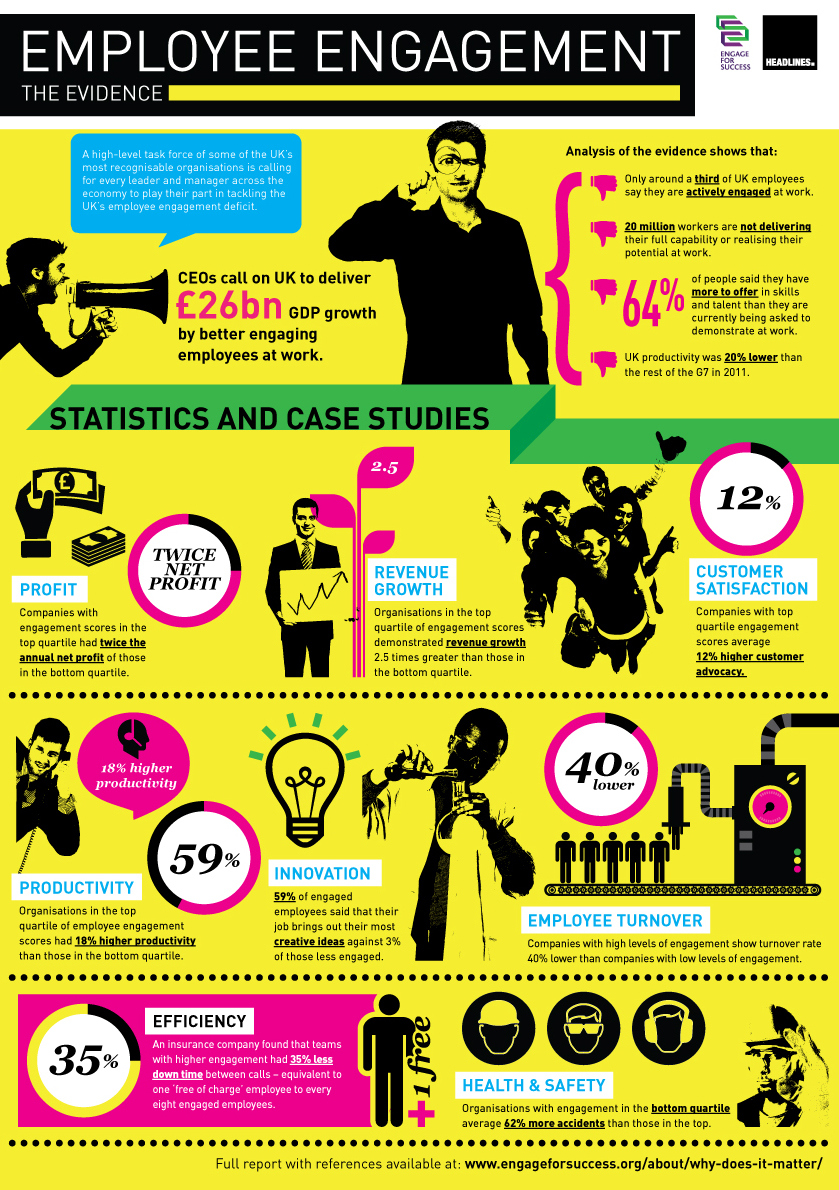

There's been a lot written about employee engagement as a concept.  Lots of more talented bloggers than I have given their views, and I'll try to reference some here.  For a good critique of the concept then I'd recommend you read this by Rob Briner.

But for now let's pretend we all agree employee engagement is a good thing and there's evidence to support it.

I was going to abbreviate employee engagment to EE but then I've had "dealings" with that company over the years and they are most definitely NOT a good thing, at least as far as customer service goes in my experience.  So no abbreviations please.

The E4S (sorry, I can't even stick to my own rules) event had some good presentations from The Co-operative Group, United Utilities and ACAS (the excellent Peter Monaghan again).  The slides have been made available by E4S and if you want the detail you can get it there, but in particular the talk from Louise Beardmore from United Utilities got me thinking.

She talked about the employee experience influencing (possibly creating) the customer experience.  United Utilities are subscribers to this school of thought, and they're not alone.  Both Netflix and Virgin Group have received headlines about their approach to this in recent times.

There's also stuff published online about this, both in the article here and by Gemma Reucroft in her blog.  So its not a new concept, but why do so many organisations struggle with it?

If customers give an organisation what it needs (usually, but not always, money, but at the very least a continued demand for its products and/or services), and so much of what differentiates an organisation from its competitors is the intangible skills and knowledge of its employees who win new customers, ensure repeat custom and do their utmost to impress existing ones - then organisations would be foolish to ignore the employee experience as being at the heart of this.

I often compare the relationship one has with ones' employer to the relationship one has with a partner.  In fact I'll blog more about that in a future post, but for now let's imagine you're out socially and get asked if you have a partner and what are they like.  If your relationship with them is strong, you'll respond positively.  If you're going through a bad patch, you might give a very non-committal answer.  If things are genuinely poor, you might even have a moan about them.  Either way, the person you're speaking to is going to get an instant impression about your partner that will be difficult for them to shake.  They would also get an instant impression about how your partner must treat you in order for you to feel that way about your partner.  Some of these impressions may be inaccurate, but some will be very accurate and it would affect that persons' view of your partner and your relationship.

Its the same with employers.  If you're enjoying work and are treated well, you'll tell people when asked about your work.  The opposite is also true.

But look at how some organisations literally jump all over social media for customers - I've lost track of the times I have tweeted an organisation and had pretty much an instant response via Twitter, and some hours later got a total and satisfactory resolution to my problem.  That's a great customer experience, but do organisations jump all over the slightest grumble or complaint from employees in the same way?

I'm not sure they do.  But they should.

United Utilities mentioned having data on employees and their interactions and wants.  I think this is a good idea and is something I've mentioned to organisations I've worked with in the past.

If an organisation can collect stacks of data about its customers and use this in some CRM style interface / system, and tailor services and products around what that customer has said, done and tweeted - then the same ought to be possible, and desirable, for employees.  
Obviously you'd have to have a sufficient number of employees if you wanted a technical solution to this, but even with a small number of employees it ought to be possible in a more informal way.

For example most HR systems I've seen store a lot of data about employees - personal details, L&D record, leave records etc.  All of this data is relatively static, and although used for statistical purposes I haven't seen many systems, or organisations, who actively use this data to segment employees and map the employee journey in the same way they would a customer group.  And I haven't seen many HR systems that have a record of EVERY employee interaction with the organisation and that tailor services and the employee experience based on these.

Look at how Facebook has tailored adverts based on things you've clicked on.  Its like witchcraft sometimes, but the technology is there.  My entire online experience is usually tailored based on my past habits (careful...not THOSE habits).

So I think organisations could unlock a greater amount of employee engagement by focusing on the employee experience, and tailoring that to the individual employee.

Taking this line of thought further, in this scenario your line managers are your equivalent of the Twitter Customer Service teams, jumping on any employee interaction and resolving it.  And your employees are your sales team, actively selling the organisation and its products/services to customers.

Many organisations are experiencing rapid and often large-scale change.  It can be difficult to maintain employee engagement when going through change.  Perhaps if organisations looked a bit more at the employee experience, engagement might take care of itself - both for employees and for customers.

Till next time.

Gary

PS in other news, some VERY exciting news due imminently about the impact this blog has had and where its going in the future...watch this space!

Friday, 11 September 2015

Sex

I thought that might get your attention.

It hopefully won't have escaped your attention that there has been somewhat of a media storm in the last few days about someone using LinkedIn in perhaps the way its creators didn't intend.

If you don't know what I'm on about, read THIS, to save me summarising what seems to have happened.

And then all hell has broken loose, with as many people criticising the victim as the perpetrator.

Frankly, its got a bit out of proportion now.

Look at THIS article from The Telegraph which outlines how the storm has since developed, and which highlights further unsavoury developments on both sides.

And then The Daily Mail, often considered a bastion of common sense and objectivity, entered the fray with THIS article in order to pour more oil on the burning fire.

What this tells me is that NOTHING, absolutely nothing, is safe or considered a no-go area by the media chasing a story.  The Mail article goes back ten years into the woman's past to dig up stories about parking tickets in order to justify their angle on her.  And various people have accessed Facebook comments that both parties have made about other people - presumably on private accounts.

If you haven't Googled yourself recently, I'd suggest you do.  And not just the first page either, or the second, get through pages 1-10 and see what's out there.  And then do pages 11-20.  And you're still not truly safe, because a reporter would find more.

Anyway, what about the use of LinkedIn to pass on compliments to another person?

Now, I realise I used my last blog to talk about gender imbalance in HR.  So apologies if this touches a little on the same area.

But sex sells.  Or sells newspapers at least.

The perpetrator in the LinkedIn storm says that he was merely passing on positive comments about the professional and well-photographed nature of the victim's profile picture as opposed to the poorly photographed ones presented by others, presumably.

That sound you hear is the sound of straws being clutched at.

I think the man sent the woman a compliment because he liked her picture, fancied her even.

But does that make it right?

Certainly there's enough people defending him, saying that he meant it in good faith. But it strikes me that he was trying to use LinkedIn like a dating site.  That's not to take either side, that's just how it looks to me.

As pointed out in some of the media articles, there are dating sites for professionals.  There are dating sites for non-professionals too, and I've experience of both during my phase as @Single_Man_75 and in my previous blog.  Tinder, POF, Match.com, and the more professional sites - I tried them all in that phase.  I wrote a blog about it twice a week for 18 months that was read by 4,000 people at one point.

But never did I think to use LinkedIn for that type of thing.  Twitter and Facebook, yes, but not LinkedIn. There's got to be a line.

And yet...and yet...I've had it done to me via LinkedIn.  Once someone tracked me down via LinkedIn (the only way I could be easily found apparently) to ask me out - and we did go out, but that's all I will say as that's a very sensitive (and explosive) story.  And very very recently I met someone for coffee whose opening line was "you've got a lovely profile picture on LinkedIn".

Now, isn't the latter more or less what the perpetrator did on LinkedIn this week?

I was a bit flustered because I hadn't expected it.  My profile picture is a professional one done by The Headshot Guy (freebie at a conference), which I think is a good one considering, well, you know, but never did I think someone would pay me a compliment over it.

And when they did, my reaction was initially confusion, and then vague embarrassment.  I didn't think to do what this weeks' victim did.

But if I had, I might have had the media attention myself, just a few days earlier.

I think my experience shows that the case this week isn't an isolated one.  Again though that's not to suggest its right, and maybe the victim was doing society a favour by highlighting that it does go on in the hope that making it visible stops it.

But sex does sell, so maybe an attractive profile picture does garner more views.  I don't get many on LinkedIn, and views seem to be split 50/50 men to women, but then maybe I appeal to both sexes.  Now and again I will post a picture of myself in my tight lycra trisuit on Twitter, no-one comments though but who knows what they do in the privacy of their own house?

So where does this leave us?

I think people will use LinkedIn as a substitute dating site, though I don't condone this.  Hopefully this weeks' story will prevent it happening again, because to upset people in doing so isn't good.  And as we all know in HR, its the perception of the comment, not the intention, that matters.

And you'd think a lawyer would know that better than most.

I'll leave you with the thought that there are plenty of people who would love to be paid a compliment, and would welcome it too, but who just don't get any.  You never know when you've received your last compliment, so my view is to treasure them when they do come.

Just stay on the right side of the line.

Till next time.

Gary

PS in other news, a busy period for me triathlon-wise as I've got 3 races in 21 days.  I may be tired at the end of that...

Sunday, 30 August 2015

The only man in the village

Recently I've been reflecting on being part of a minority group - men in the HR profession. I thought I'd spend this blog sharing my observations about this and what impact it has, if any. 

Read on...

I've encountered it all over the place so it's definitely a thing. But it's taken other people pointing it out recently to make me dwell upon it. 

In my current role and organisation I'm the only man in an HR section of 18. In my previous two organisations out of a total of around 30 different HR professionals in two companies I was one of only three men across both. In my work delivering CIPD qualifications for six years, I taught around 120 students and can recall only five male students. When I was a CIPD student myself I was the only man on the course for each year I studied.

I go to conferences and networking events and the audience and attendees are predominantly female. 

The CIPD once said that 72% of their members are female. In another bit of teaching I do, student numbers are almost exclusively female too and it's estimated that over 80% of new entrants to the HR profession are female. 

And there's lots of other statistical evidence on the subject too.

But do I mind?

I might well be in a minority group but I don't feel neglected, disregarded, discriminated against or otherwise excluded, for the majority of the time anyway. It doesn't bother me much. Once I did joke that I was the token male and felt like some kind of positive action role model, but that was in jest. It did make me think though about why women outnumber men so much in our profession?

I put a lot of stock by Allen and Barbara Pease' research on the differences between men and women. Although delivered HERE in a very light hearted way, there's a considerable body of research behind it and some relevant truths to explore too. He doesn't mention HR in this when he talks about professions and occupations with high gender imbalance, but the principles are the same - you can see lots of HR work being perceived in the same way as Counselling, which he does mention - as a fluffy, talking profession where you listen to lots of people complaining. 

I generalise, of course, and am just extending Pease' anecdote. But is this why the HR profession attracts more women than it does men? There's certainly not much of the geo-spatial and logistical co ordination Pease asserts attracts more men. Though there IS a lot of problem solving. 

What do you think?

Interestingly though when you look at the top levels of the HR profession, the numbers are a lot more equally divided. This suggests that whatever barriers there may be to men entering the profession, there are not as many preventing men from succeeding and advancing in the profession once they have entered it. Or does it suggest that the further away from the front line of HR you get, the less those types of roles are likely to be attractive to women? Again, just referencing Pease' line of thinking here. 

Pease also suggests that there is something about how the brains of gay men work that enables better relationships to be forged with women, and to share some of the same characteristics in terms of skills at certain jobs and attributes to succeed in them. Although this is another generalisation, there is some relevance to HR as a profession where there does seem to be a higher proportion of gay men than in some other professions. Indeed, of the various men I have referenced in my introduction above as having been part of my peer groups, around half have been gay, and it's often been the case that people have assumed that I myself am gay simply because I'm a man working in HR. Again, this doesn't bother me at all, but it's interesting how stereotypes start to develop. 

Hence the title of this blog, a reference to the Little Britain character Daffyd and for a good illustration of this, this sketch in particular. It's how I sometimes feel when I encounter another man in my HR team. 

A while back a team I was in were looking to arrange an Awayday that included a fun element and various options were presented for the team to choose from. The menu of choices included some things that were definitely aimed towards the female dominated team, though that's not to say that I might not have enjoyed them too or that some of the women may have disliked them, just that it would have been outside my comfort zone and there were no activities that catered exclusively for the male minority - and perhaps that's entirely right, after all I'm a minority of one and it's difficult to cater for all. 

On a recent training course there was just me and one other man in a group of 13 trainees, and at one stage the trainer made reference to this in order to make a point. I didn't mind, and the trainer herself admitted she was taking a risk by raising the point, but it again highlighted how obvious it must be to those looking at the HR profession from outside it. 

Interestingly though, with equal pay increasingly in the limelight and seemingly due to expand its legislative range soon, this article suggests that men in HR tend to receive higher salaries than women - which can't be a situation anyone in the profession is proud of. 

Earlier this year, David Jackson (who you should all be following on Twitter) wrote about it in his own blog, from which I've taken some inspiration.

We aren't the only profession with such a gender imbalance though. For the reverse situation, see IT in this article.

In David's blog he poses the question should we be bothered by the statistical imbalance?

That's a good question but I'm inclined to say no. Until someone can prove that HR needs more men in order to be more effective, and IT needs more women in order to be more effective, I can't see a compelling case for doing anything at all.  Yes, there are minority groups and I'm one of them. But it's not doing any harm, or preventing anything from happening, as far as I can see at least. 

It's just a statistical phenomenon. 


Its not causing me any problems.  And I haven't heard any other man complaining either.

If I'm the only man in the village, so be it. 


What do you think?

Till next time...

Gary

PS in other news, wedding invites now issued and it's just one year till the big day! Oh, and Poppy FINALLY slept through the night for the first time in ten months!

Sunday, 16 August 2015

Life begins at 40...or does it?

Recently I turned 40. On 17 July in fact - telling you this so you can put in a reminder for next year when I'm 41, I'm expecting a card!  There's a popular saying about Life begins at 40, and this was uppermost in my mind for a few months beforehand. In this blog I'll discuss whether such a thing is true, and reflect on what it means to be 40 in this modern world. 

I recall when I was but a mere accounts assistant at ICI in the mid 1990s my immediate line manager turned 30. I was only 21 but 30 seemed old, very old. I distinctly remember teasing him all day that he was now closer to 40 than 20 and how annoyed he got about this.

And now I'm closer to 60 than 20, how's that for karma?

Somewhere Rob Stockton is quietly chuckling to himself. Rob - I owe you an apology. 

So I wasn't particularly keen on turning 40 lest someone tease me in a similar manner. You see, I can give it out, but I can't take it. 

So I wasn't too happy. I remember my Dad turning 40 when I was a teenager and him seeming very old, my mum likewise. And my grandparents were in their 40s when I was born and have never seemed anything but ancient, so is this how I must look to my children?

I decided to end my 30s in style. I celebrated for four consecutive days, at work with my old management team, with my family, and with my friends. It was good, even if someone did injure themselves at my party. 

But where does this feeling that life begins at 40 come from, and does it still hold true in the modern, digital age? American psychologist Walter Pitkin popularised the phrase in his 1932 book, but prior to that average life expectancy itself hadn't been much more than 40. It is supposed to represent the beginning of the time when a person feels more financially secure and, if they have children, they are approaching self sufficiency. 

Well that's not true for me. I don't feel financially secure, although admittedly more secure than when I was 20 or 30. And my children are nowhere near being self sufficient, financially or otherwise. In fact, just last night I had to borrow £1 off my Dad, so maybe I'm not even self sufficient yet either. 

This article suggests that 40 heralds the beginning of the end, bringing the time when forgetfulness, lack of concentration and poor focus become more apparent. 

So is this what awaits me? Well from a career perspective and looking above and ahead of me in my organisation, sector and profession, there are plenty of people 15-20 years older than me, and more, doing great things in their working lives and I see no evidence of them failing anything. 

And yet...

...my paternal grandfather had to finish work through ill health at age 48...my father had to finish work through ill health at age 42...and my paternal uncle only made it into his early 50s before he too finished work. Perhaps there's something genetic about it?

Even this article suggests that men usually don't feel settled and secure until age 54. So does life begin at 54 nowadays?

I guess it could. If people are taking longer to get onto the housing ladder then a mortgage could easily last until someone is 60. Careers are longer, so on average most people will be made redundant once and have one complete career change, and someone in their early 50s could be starting out on a brand new and more successful career. And with children often arriving later in life, a parent could be in their mid 50s before those children are self sufficient. 

So maybe I will be ok. I've always been the youngest on any management team I have been part of, and whilst I've lost that title recently I'm still one of the youngest, so life could yet begin for me at 40. 

And I feel quite good at 40. Family wise, I'm in a much better place than at any other time I can remember. Physically and mentally, I'm in great shape, again far better than at any other comparable time. Career wise, I've had a great last decade and a half and am in a good position to shape my own future over the next decade and a half. And THEN I might feel financially secure. 

Plus I lost my hair in my early 20s and have looked 40 for a long time. But now I actually AM 40, I think I'm looking pretty good for it. 

I was going to say I look pretty hot, but that might be stretching it. 

Basically that's the Bobby Charlton rule though. He looked 60 when he was 20, but by the time he was 60 he had grown into his looks and age. And there's more. Look at Gary Barlow and Jamie Redknapp, and David Beckham, all men who seem to be better at age 40ish than 20 years earlier. 

So maybe 40 is the new 20.

Certainly it could be for me. I feel more energised at 40 than I did at 18, 21, 30 or any other milestone I can remember. 

This blog is called the Power of Three and on the About Me page you can see why. But for me I think I've got things balanced nicely at the moment, having given the necessary attention to each area. I hope I can give others some ideas on how to balance theirs too.

But then I could give my younger self some advice, but I know I wouldn't have listened to it. 

Someone once said that at 40 you develop judgement. Let's see if I have. I've got a big decade ahead. 

Till next time...

Gary

PS in other news, hopefully you'll forgive the indulgence of a very personal blog. Back to a more professional one next time round...

Monday, 3 August 2015

Incommunicado

I haven't blogged for a few weeks as I've been on holiday. I deliberately turned off my work emails and calls during the holiday and went almost two weeks without interruptions from my professional life. 

Here's why, and what I learned. 

This was my second holiday of the year. We went to South Devon and had a lovely time. But it was in my first holiday this year that I got the idea. Back in early May we went to the far North of Scotland and whilst there we had no wifi or mobile phone signal. There were occasions where signal would break through or where we visited a place that had free wifi, and on those occasions work emails and voicemails would push through and, by and large, I'd spend some time looking at them in case there was anything earth shattering. Whilst this made me feel alright about work pressures, I couldn't help but notice the glances from my partner and also the things I was missing out on, like quality family time. 

So I figured this time round I'd turn them off completely.

I think people reading this will be divided into two camps.  One camp will be thinking "its a holiday, why on earth would you be checking emails and voiemails? Are you mad?".  And the other camp will be thinking "of course if you have an important job you should keep in touch".

This has been a subject covered in the media in recent years. Germany is considering banning outside working hours contact for example.

France already has.

A lot of these come from the angle of reducing stress for the individual. I should clarify that my decision had nothing to do with reducing work stress, and everything to do with increasing the quality of the time I spend with my family. I don't often get stressed by work and sometimes the ability to clear a few emails whilst sat on the balcony overlooking the hotel pool whilst the kids are asleep has been actually helpful from a work perspective. 

After all, there was a risk that I would return to work facing an uphill battle to get my workload back on an even keel, a subject even the CIPD weighed in on recently.

In previous holidays I'd always checked work emails and voicemails, and had sent quick replies to things that "only took a minute" or which appeared very urgent. In my head I was underlining how vitally important I was that I couldn't even switch off on holiday and needed to keep a watching eye on things back at work. In fact, one wondered if work could even carry on without me.

How utterly wrong I was, and how ridiculous I must have seemed. 

There's also the risk that you'll read an email or listen to a voicemail that will get you so riled up it spoils your holiday. That hasn't happened to me but I've seen someone else do it, read an email whilst abroad and get so stressed about it that they went off sick through anxiety at the end of their leave. 

So beforehand I was determined to switch off and enjoy my family time, the first holiday I'd taken with my partner and all three of my children. 

Of course I had to make sure that I'd finished everything I could beforehand, left as few loose ends as possible and let key people know that I'd be back in a fortnight and to save anything urgent till then, as well as briefing anyone else who I needed to do anything during my absence. I worked harder in the days leading up to this than at any recent time in order to achieve this. 

During the fortnight (well, 12 days actually but fortnight sounds better) I thought I'd be tempted to turn things back on sneakily, but surprised myself by mentally switching off too. That's not to say I didn't think about work at all. I did, quite a few times. It's a big part of my life and there is a lot happening at the moment. But I didn't fret about it. I figured people could get hold of me in an absolute emergency, but I knew I'd set things up well enough not to worry for a fortnight. 

And here's the thing. I enjoyed my holiday more as a result, and our family time was amazing. And guess what? My company was still there when I got back this week. Nothing drastic had happened and although there were many hundreds of emails to wade through when I returned and a number of voicemails, some of these had sorted themselves in my absence WITHOUT MY INTERVENTION. 

Like magic. 

I guess no one is irreplaceable. But, saying that, I still hope David De Gea stays at United because he comes pretty close to being irreplaceable. 

Afterwards I felt a little guilty but tried to tell people when they asked that, of course I'd enjoyed my holiday (that's what everyone says), but a factor in that was being able to switch off. 

I had to work just as hard in my first few days back as I had done in my final few days before the holiday, but I felt better about it and felt that my mind was clear and part of me actually enjoyed being back at work as in some way I'd missed it. 

But rather that than my family miss me while I'm on holiday with them because I'm "just quickly checking emails". 

So here I am, back at work, and feeling refreshed. 

Would I do it again?

Yes. To me the pros far outweigh the cons. 

But..what do you think? What have your experiences been?

Till next time...

Gary

PS in other news, I turned 40 during the holiday. Quite a fright. But a good opportunity to reflect on life, and I might share my views on turning 40 in my next blog...

Monday, 13 July 2015

Lets get analytical

A week or so back I attended an HR analytics conference run by Symposium Events. I'd done this because of my growing interest in both predictive analytics and in making our existing static HR data more meaningful. 

Here's my thoughts on the topic. 

My interest has been growing for the last year or so, promoted partly by the creation of the Torus Group and the need for that organisation to realise some big efficiencies over the next few years in a changing and more challenging environment. I started wondering how much HR could contribute to this and began looking at what we did and what others did. 

I concluded that too much of HR data, both in and outside my organisation, was just sitting there and wasn't being actively sought by the business to drive better decision making and improve performance. It was static, retrospective and didn't go much beyond benchmarking in terms of analysis. 

In short, too many HR departments prided themselves on their ability to manipulate systems to extract mounds of data that was then published to people who didn't look at it, or just looked at it and nodded. 

That wasn't good enough then and as my thinking has developed, I know it's definitely not good enough for the future if HR is to justify its seat at the boardroom table. 

So where do we need to get to?

The conference underlined for me the importance of an MI Analyst role in HR, not just to own the data and its production, but to draw conclusions and offer insights. Particularly for organisations with over 1,000 staff. This role would help us to move towards modelling of data and root cause analysis to identify issues and offer solutions. From there we could move to scenario planning and predictive analysis, and link the data analysis to risk analysis and strategic planning. I don't think this person would have an HR background either, probably better that they don't.

I think, though, having a data analyst in the team is only half the solution. We need to understand what the problem is we are trying to solve with improved analytics. What are the most important things the organisation needs to focus on and which interventions would have the most impact on these things?

In the conference, questions were asked about what aspects of culture impede customer service, and what we can do to improve innovation. You'd also include things like an analysis of complaints or compliments data against specific groups of the workforce, maybe at an individual level, to look at what your best performers do to influence customer satisfaction, or what the worst do. You'd look at recruitment data and where you found your best performers, and whether certain recruitment sources provide better performers than others. You'd also want to explore the link between recruitment and performance data, and absence/performance and behavioural data. There's loads of possibilities. 

Basically, HR needs to find data correlations and use them to start a wider dialogue and build credibility. Don't rush in throwing statistics at the organisation without having some context and understanding the organisational problems first.

I tweeted at the conference that HR needs to focus on what will keep Executives awake in the NEXT few years, not what has been keeping them awake this year or last year. 

Of course there are obstacles, as the conference highlighted. The lack of analytical skills or investment in analytical systems is one, as is lack of support from management or hard to access or hard to correlate data. But that shouldn't stop you from having a go. 

To combat the lack of skills, look to develop them in house. Get HR BPs involved in brainstorming correlations in data, generating hypotheses and going looking for data to support or disprove them. HR BPs should be challenging the data, asking so what, and why, as often as possible.

I think it may be easier to start with a pilot of predictive analytics, in one small area, perhaps an easily benchmarkable one that is present in other organisations, like call centre staff. Do some data correlations there, perhaps using one of the data sets that is easy to identify and measure, for example diversity statistics. Although at the conference I tweeted some of the possible areas of difficulty this could lead one to, but at least it's a start.

Ultimately with predictive analytics we could get to Amazon-style customisation of jobs and work for employees, with work and work environments tailored to produce high performance based on how we know performance and engagement has been generated in the past. I might do a follow up blog on this. 

I'm looking to test predictive analytics soon to see what can be done and learn from it. If anyone has any lessons they can share, I'd be interested to hear them. 

Till next time...

Gary

Ps in other news, I turn 40 this week, a major milestone and a natural opportunity to stop and reflect on things. There's a few bits of celebrating to do first though. Or is that commiserating?

Friday, 3 July 2015

Defusing the timebomb

This week I attended The Future of People Management, a joint conference from Acas NW and CIPD Manchester branch. It contained a range of speakers on topics related to how the world of work will change in the next 10 years as a result of unalterable demographics and social changes. Here's my summary of and thoughts on the event. 

It's only a summary though of the main points that grabbed me, it's impossible to capture everything from everyone without making this post too long. However, should you want to read in depth about some of the research referred to by many of the speakers, check out THIS from CIPD. Even if you just read the Executive Summary it's enough. 


First up was Professor Steven Taylor giving a good visual run through of the key demographic trends and graphs. He summarised the main implications for HR were about our capacity to deal with a VUCA  world, how flexible we can be in responding to change, how we can overcome resource limitations to demonstrate added value and how we need to up our game in terms of talent attraction and management. I'd not argue with that, and indeed he said that skills shortages and tight labour markets are likely to push recruitment and retention to the top of the organisational agenda for the next ten years. This is in sharp contrast to the employee relations and downsizing agenda of the last ten years and I wonder how many HR professionals will be able to re skill accordingly?

Taylor also called for an updated version of the Leitch Report to take account of new employment and economic trends and realities, something which I would second. 

He also pointed out that if current rates of net population increase continue, the UK will reach 80m by the middle of the century and become the largest country in Europe.  Taylor was of the opinion that this should not be allowed to happen if we are to remain competitive, and I'm unsure if I agree with this, what do you think?

Next up was Peter Monaghan from ACAS NW talking about rebooting the psychological contract and what that means for HR as expectations of employees and employers change. There were a few generalisations in Peter's talk, which he acknowledged, such as older workers being culturally stuck, but in the main I agreed with what he said.

Peter tried to redefine the psychological contract, speculating on what employees and employers would expect from each other over the next ten years.  Below is his list, which attracted some criticism on Twitter for being outdated but in my opinion many employers have yet to wake up to this reality let alone consider it outdated.  Anyway. His list:

Employees should promise to:
- be productive
- be flexible in return for flexibility
- be loyal in return for loyalty
- give great customer service
- be innovative
- be collaborative
- commit to their own development, 
- be honest
- not to do daft things on social media

And employers should promise to:
- provide a pleasant and safe work environment
- listen and act on employee feedback, 
- provide opportunities to collaborate, 
- provide opportunities for flexible working
- provide opportunities for development
- recognise and praise great work
- provide their best in terms of pay and job security

As examples of companies who are doing this, Peter encouraged us to look at Virgin Group, Netflix and Zappos. Of these, I do struggle to get my head around the unique management culture in Zappos and think that's maybe too far too soon. 

Also worth a read on this subject is THIS recommended by Peter and quite relevant. 

After Peter came Professor Carol Atkinson on redefining wellbeing. She talked creating an environment which allows an employee to flourish and achieve their full potential for the benefit of themselves and their organisation, and how some organisations are doing this. 

Peter Cheese, unexpectedly delayed in the morning, opened up after lunch. I found his talk very interesting on the challenges facing the HR profession in the future, and he shared some eye opening statistics that illustrates the size of the challenge. For example, 65% of today's school children will end up doing jobs not yet invented, and most of the top 10% "in demand" roles today didn't exist ten years ago. 

That's scary. And yet most of the audience were in HR ten years ago and probably hoped to be in HR in ten years time (not me though, I still think there is time for me to become a professional wrestler). So I'm not convinced HR as a profession has evolved in quite the same way or at the same speed. What makes us think that HR is needed in ten years time and if it is, how will we come to understand the jobs our children will be doing?

The final two speakers had hard acts to follow after these.  Cathy Brown spoke about how engaging managers focus their people, treat them as individuals, coach and stretch them - and plugged the Engage 4 Success brand which is worth checking out.  Finally, Emma Swan from Taylors Law talked about how workplace flexibility is the biggest challenge for many of her clients, and how we need to ensure mutually beneficial outcomes.

And then I left.

The conference was in a wonderful building at MMU, easily accessible by public transport but not so easy for those of us in a car.

Overall I enjoyed the conference and left with a lot to think about, both in terms of how I apply the learning and knowledge in my current role but how I can develop my own thinking on future-proofing the workforce and defusing the demographic timebomb that approaches.

I've got some thoughts developing already and will share some of these in an upcoming blog post.

Did you attend this conference and, if so, what were your thoughts on it?  Even if you didn't, what are your thoughts on the future of work as outlined by some of the speakers?

Till next time...

Gary

PS in other news, my fiancee has gone back to work after maternity leave this week and our daughter has gone to nursery at the tender age of 8 months.  She has cried each morning and its been hard on us all.  So I've been a bit distracted this week.  Hopefully she will settle.