Friday, 30 October 2015

2040 vision

I realised when reading an article in the most recent issue of People Management that I'm still (at least) 25 years away from retirement as we understand the concept now, and therefore am not even halfway through my working life.

That's a scary thought even if it is Halloween today.

It kind of puts recent thoughts and discussions about my on future into perspective. I've been with my current employer for 11.5 years and I've never been anywhere that long, and yet with 25 years left (assuming I retire at 65) I could surpass that in two different organisations before I retire, so maybe 11.5 years isn't so long after all...

Here's the article that prompted my thinking and this blog post anyway.

Basically, I realised how outdated my thinking and some organisational thinking is about the whole concept of employment and careers.

Recently I've been talking to colleagues in my organisation about becoming Fit for the Future, looking at how we become the employer of the future. In doing so I drew comparisons with what it was like when I started work at ICI in 1986 and highlighting how different the world and concept of work is 19 years later. I was trying to get them to imagine how different work might be in another 19 years, but only a few grasped this with any clarity and most could only conceptualise to the end of their own careers in the next 5 years or so, and couldn't envisage any major changes.

So we often talk about 2020 and having 20:20 vision. But I'm still going to be in the workforce at 2040 and I'm trying to change peoples ideas and concepts about what working life may be like then, and in particular from an HR perspective what employment arrangements might look like.

The world of work my children enter in 10-15 years time will be almost unrecognisable from that I entered in 1996, but it's being shaped largely by people whose ideas of work and employment are based around that imparted by their own parents and shaped by their own experiences in the last 20 years or so. It's like we are reacting to events rather than proactively planning a future for our children to work in and finding out what they want.

I work a lot in the housing sector and it's not unreasonable to expect a house built now to last 100 years, and for the main components within the house (kitchens, bathrooms, electrical wiring etc) to be replaced 5 times in that lifespan. So organisations working in housing are good at thinking long term from a customer perspective and product perspective, but with the average career now lasting around 50 years I am finding few people in any sector are planning for employees lasting that long.

As Jo Faragher points out in her article, the concept of permanent work is on the decline. Interim contract usage is up 93% in recent years, and 6% of the UK workforce work on temporary, interim or other fixed term contracts. Non permanent staff are an integral part of organisational workforces and for many it's a way of life that suits them and still allows them to be engaged and embedded. Indeed, the article comments that some agencies have now started paying their contractors for "bench time" in between assignments, something I think may catch on.

With a range of contractual arrangements now on offer from some organisations, it may be time to revisit the old Atkinson Model of the Flexible Firm that I remember from my studying and teaching days. 15 years ago it was an idea probably ahead of its time, but very perceptive and one that has accurately foretold how work will evolve, and will continue to evolve in the coming years. Organisations will increasingly operate on a model that has a minority of core, permanently contracted workers, and a majority of flexible and peripheral staff who give their all whilst working for that organisation, but who are not tied to that organisation or the need to work full time and build a 50 year career.


This idea redefines what work actually is and celebrates the diversity of working arrangements that can be implemented. The UK is due to fall off the workforce cliff by 2021, so if we are going to remain competitive then we need to attract the best of the younger workforce, retain the best of the older workforce AND appeal to the one fifth of the UK population who aren't economically active but could be.

Tall order, and it's a good job I've already lost my hair.

But it strikes me that the best way of doing this is to offer different working arrangements. Different times yes, different contractual ties too and different terms and conditions to suit. But I don't see many organisations adapting and evolving in such a way, and many see the employment relationship as an exclusive one in a very old fashioned way.  Why can't workers have relationships with lots of organisations?

(my oft-referred to concept of looking at the employment relationship the same way as personal relationships just took a whole new turn...)

I also think that organisations need to think longer term in terms of their attraction strategies. This goes beyond community management (alumni, referral schemes, apprenticeships, partnerships with local colleges, social media groups and customer interactions) which is a good recruitment practice in and of itself, but looks at what the majority of workers due to ENTER the workforce in 10 - 15 years time actually want. This may sound daft, but that involves talking to children of primary school age and building links with them before they reach the age of 10, not just when they're in college or university - by which time its too late.

Thinking about it, football clubs are amongst the few organisations that DO do this. When my son used to play under 8s football there were scouts there watching from professional clubs, and having spoken to a few of them they always stressed the importance of spotting talent aged 6 - 7, and nurturing that talent over a 10 - 12 year period before they could actually employ that individual and get something productive back from them - and that if a child hadn't been "recruited" by the age of 8, they knew they'd never make it as a professional footballer.

But aside from football clubs, what businesses follow this pattern and actively engage with the talent of the future 10 - 12 years before they come to work for them?

Maybe we should. Maybe we'd find out a bit about what they want us to do for them when they DO work for us. What hours they want, what pay they want, what benefits and what engagement.

I think we'd find that very few expect to work the way we, their parents and grandparents, work.

And even fewer have a concept of being engaged with and tied to one organisation on a permanent basis.

Food for thought.

Till next time...

Gary

PS in other news, Poppy turned one this week and we had a good couple of days celebrating. She hasn't adjusted to the clocks going back though and has been getting up at 5.30am most days, so we're all dead on our feet...and I thought I was fitter than I used to be...

Thursday, 22 October 2015

Baby blues

On 26 October 2014 my beautiful youngest child, Poppy, was born.  Its been a really good year, but earlier in the year my partner and I encountered some treatment linked to Poppy that caused us a lot of upset and heartache.

Given the recent publicity around #motherswork2015 and Best Companies style lists like THIS, I thought I'd share some aspects of this and how it affected us, along with my views on what can be done in the modern world about such treatment.

I've been prompted in part by reading two blogs from @HR_Gem on this subject, something she feels very strongly about.  You can read these blogs HERE, and HERE.

Go on, read them.  And then come back here.  I'll wait.

Done?

The CIPD talks about improving working lives and both Gem and I think there is a real need for a body like the CIPD to add its weight to improving working lives not just for mothers, but parents in general, and carers and grandparents too.

Maternity Action is a good group and well organised, but has the feel of a fringe protest group and it shouldn't.  It may take a body like CIPD, or the CBI, to wade into this issue before its taken more seriously.

There is a lot of evidence that pregnancy discrimination is rife in British industry.

And so I learnt this year.

My partner wished to return to work at the end of her full maternity leave but wished to do so on a part time basis, and submitted a flexible working request that took the company over two months to respond to, which in itself is unacceptable.  The response was to refuse the part time work on the basis that there was an inability to reorganise the work of the department.  They said she could only return full time.

As a result of this, my partner was left with no choice but to resign as neither of us felt our family could sustain a full time return to work.

And that might have been it, had I not got an HR background and could immediately see flaws in their process, decision-making and logic.  And helped my partner to do so and reach an outcome that we found acceptable (ultimately though still resigning and finding, almost immediately, an almost identical job on a part-time basis - which in itself made a mockery of some of the arguments put forward by the employer about the feasibility of and ability to recruit to part time roles).

The survey cited earlier suggested that this kind of situation is extremely common but that few women actually do anything about it.  We were lucky that I had a relevant professional background that was helpful, but how many other women just accept their lot and bow to their employers' demands or resign and struggle financially?

Worse, how many organisations have qualified HR professionals working for them who stand by and let this behaviour and treatment carry on?

What did we enter HR for if not to stand up for certain values and ethics?  Does our professional standing mean nothing?

HR's role is to support the business and to help it perform, but not - surely - at the cost of ignoring our hearts and what we know is right?  HR's role should be to be the heartbeat, soul and conscience of the organisation, upholding principles, values and ethics that see people treated fairly.

In general though outdated attitudes such as those that allow such treatment and those experienced and talked about by Gem shouldn't exist in this day and age, and its sad that they do.  I've been lucky to work for progressive, enlightened employers but maybe I've been sheltered from reality.

But the world of work has changed.  Back in 1996 when I first started working in a "proper" job there was very little technology, there was no homeworking, you could smoke at your desk, it was considered "manly" to have 5 pints on a Friday lunchtime and spend Friday afternoon doing little other than sobering up, you called the Chief Executive "Sir" or "Mr" and the executive floor had plusher carpets and nice smelling toilets compared to the other floors.  And that's less than 20 years ago.  So how come so much has changed so much but some other things, like attitudes towards parents and carers, have changed so little?

There's a lot of discussion about paternity leave too at the moment, and I've referenced Netflix forward-thinking approach to people management in other blogs - and here's how they treat parental leave - but maybe the UK in general is taking longer to catch on, despite some recent legislative changes.

I've been a new father three time and in none of those cases have I been able to afford, financially, to take anything more than one week off work.  The most recent time I added some annual leave on to make two weeks on full pay, but even two weeks felt like not enough and I think new fathers should ideally be able to take four weeks on full pay.  That certainly would have helped me this time last year when Poppy came along.  And my employer treated me more than fairly but I still felt like I needed more.

And now we have grandparents leave due.  I think this is long overdue.  Both of my parents, and both of my partners' parents, have long since finished work but I wonder whether any of them could have stayed economically active for longer had grandparental leave been available in days gone by?  Could this encourage grandparents to stay in work and contribute to the economy for longer?  Its got to be a good thing.

But what I've hoped to achieve with this blog is show that, in 2015, employers can still treat people badly because of issues related to their being a new parent, and that a growing minority of people now recognise that this is a bad thing.

Its time that we in HR stood up and shouted about this.  And upheld our values.

Till next time...

Gary

PS in other news, Poppy has her 1st birthday party this weekend and we are all looking forward to it - can't believe she's one year old already...

Friday, 16 October 2015

#connectinghrmcr

On Wednesday evening I attended #connectinghrmcr for the first time.  Despite such an event being well outside my comfort zone, I found that I enjoyed myself tremendously.

I had tried to attend this event twice previously, recognising it as a great networking opportunity and a chance to get to know more HR people in my region.  The first time I tried to attend, I then booked a holiday and couldn't go.  The second time I tried to attend, my partner and I had our baby the week of the event (a full two weeks late she was) and I was needed in the hospital.

So third time lucky I figured, and in light of some upcoming changes to my own role and where I might well be in the future I wanted to take the opportunity to get to #connectinghrmcr and talk to people who I thought might be able to give me some advice and even help me in the future.

So I went.  Even though I am not good at networking events.  I've said this before.

I find talking to people difficult sometimes, more so when those people are more or less complete strangers.  I can do it, but I have to feel really confident before I do, and need to have some "downtime" before it all happens.

But I have been trying to force myself out of my comfort zone and with good reason.

In order to get myself in the zone and ready for the event I tweeted a few times beforehand to see who was going and to make some initial contact.  I also had to both go for a swim at lunchtime and for a run straight after work - basically time to think and prepare and deal with my energy levels.

I find exercise and training is good quality thinking time and fuels up the introvert in me to be able to be more, well, extrovert.  I can think on my own, and there's no distractions when I'm swimming, biking or running.

But somehow this all worked.

The event was brilliant.  Full of talented, friendly, helpful and interesting people who happen to be connected through a common profession.

I was made to feel welcome, one of the crowd.  I found myself talking freely to almost everyone I met and, what's more, enjoying it.  I talked to lots of people and found loads in common.  Two colleagues came along too (@kimdillon78 and @Laura_Torus) and seemed to be enjoying it as much as I did.

I left after nearly three hours and drove home, and if it was possible to feel both buzzing and tired, then that's what I was feeling.

Doing so much talking was energy sapping.  Do you ever recall the arcade game Track and Field?  Or Daley Thompsons' Decathlon?  When running the 1500m you had a little energy bar and when that was used up the little runner used to go so slow.

I think that's what its like for me as a high introvert.  I can act extrovert when I want to be - I can stand up in front of a room of 1,000 people and deliver a cracking keynote speech, or can deliver training sessions that are inspiring or exciting and involve me being lively and energetic - and then I tell people I'm an introvert and they refuse to believe me.

But its true.  Introverts need time to fuel up the little energy bar - so hence my running and swimming before #connectinghrmcr.  They also need time afterwards to refuel, and so what you see with me after any burst of extrovert energy is me having to be mega quiet and barely talk for a few hours afterwards.

So when I got home, I could hardly speak despite my mind and brain buzzing with information.  I had no words left.

But back to #connectinghrmcr...

I'll go again.  And in fact I'm looking forward to it.  Not sure when the next one is, but I'm there.

It was refreshing to be in a room with lots of people who not only understand HR, but don't take it all too seriously and know how to laugh at themselves and our profession. To be able to talk to someone about what I do at work and not have their eyes glaze over, and to immediately both understand and sympathise with the issues others were telling me they are dealing with. To feel the enthusiasm and vibrancy in the room of people who have a real passion for people. To have conversations with people who understand how social media can make valuable and lasting connections.

Of course I can get a lot of this at work.  But this was in a bar.

With alcohol.


We did some great photos of most of the #CIPD15 blogsquad and the camaraderie was brilliant, from everyone at the whole event.
There's also the possibility of an HR blogger relay triathlon team in the offing with @HR_Gem, @fuchsia_blue and myself. 

I enjoyed meeting some people I've met once or twice before and catching up with them, like @Damiana_HR@monaghanpj and @Community_Mike, and met others who I'd only tweeted before like @KingfisherCoach, @KevWyke, @TimScottHR, @HR Em, @LizardVanilla@ryskicheyne.  And many others too numerous to mention so if I haven't mentioned you then my apologies and I'm more than happy to edit this post afterwards and add you in.

But basically if you're not already following all the people I mentioned in this post, then stop what you're doing and go and follow them.  They're all lovely.

And if you haven't been to one of these tweetups before, I can highly recommend them.

Till next time...

Gary

PS in other news, its the end of the triathlon season now (aswell as all my other summer sports) and I'm into winter training.  Roll on spring...

Wednesday, 7 October 2015

Blogsquad #CIPD15

Well here's a turn-up for the books.  I've been blogging since March, and last month the CIPD themselves noticed what I was doing, and asked me if I was going to #CIPD15 in November.

"Yes", said I.  "I haven't missed a CIPD Conference & Exhibition since I started going in 2004."

"Well", said they.  "Do you fancy blogging about it? You can be part of the official CIPD Blogsquad and you get a free ticket to both days of the conference and unrivalled access to all the sessions and speakers."

"Actually", said I, "I was probably going to blog about it anyway, but seeing as you asked so nicely, then OK."

And here we all are now.  Somehow I've managed to keep quiet about it until yesterdays big reveal by CIPD.


I'm liking the sci-fi theme of this although I'm fairly certain that the design team could have Davros-ed me up a bit given that I've spent 40 years honing just that kind of look.

So what's involved?  Well, the programme for #CIPD15 is here - take a look. Its a fantastic programme and there's some amazing speakers there.  My role, and bear in mind I'd have been going anyway, is to cover the event via this blog and report on what I see.  I'm part of a squad of more talented and more experienced HR bloggers who will also be doing the same, so between us we'll cover off the entire programme, but I'm feeling very much like the new kid on the block.

I love the CIPD Conference.  I first went in 2004 when it was in Harrogate and was blown away by the experience.  I came away from that trip absolutely loaded with reading material plus, strangely I thought at the time, free gifts from exhibitors.  When I got home it was like Xmas and birthdays all rolled into one for my children, and I don't think I've needed to buy a pen, or mints, or Celebrations, since.

The conference when at Harrogate was quite different than Manchester now - it felt bigger, despite Harrogate itself being much smaller.  But it was like the conference took over the entire town and all its hotels and bars, and everywhere you went you bumped into fellow attendees.  In Manchester, its lost in the shuffle somehow of a major metropolitan city, and doesn't feel as special even though I think the organisation and look and feel has improved.  I look forward to it every year - although the proximity of Manchester to where I live and work means that I've not been able to justify an overnight stay and experience the "evening" entertainment like I could do at Harrogate.

There's a good deal of free seminars purely in the exhibition so if you wanted to you could get a lot of value just from attending that, but the conference offers a whole lot more.

I'm excited about going, and even more so now I'm on the Blogsquad. I hope to gain a lot of knowledge and thoughts about leading-edge HR that I can take back into the workplace, aswell as give my views via this blog on the whole experience.

Bring it on.

Gary

PS in other news, Poppy turns 1 in a couple of weeks.  That's gone exceptionally quickly! How much things change in just one year...

Friday, 25 September 2015

Engage

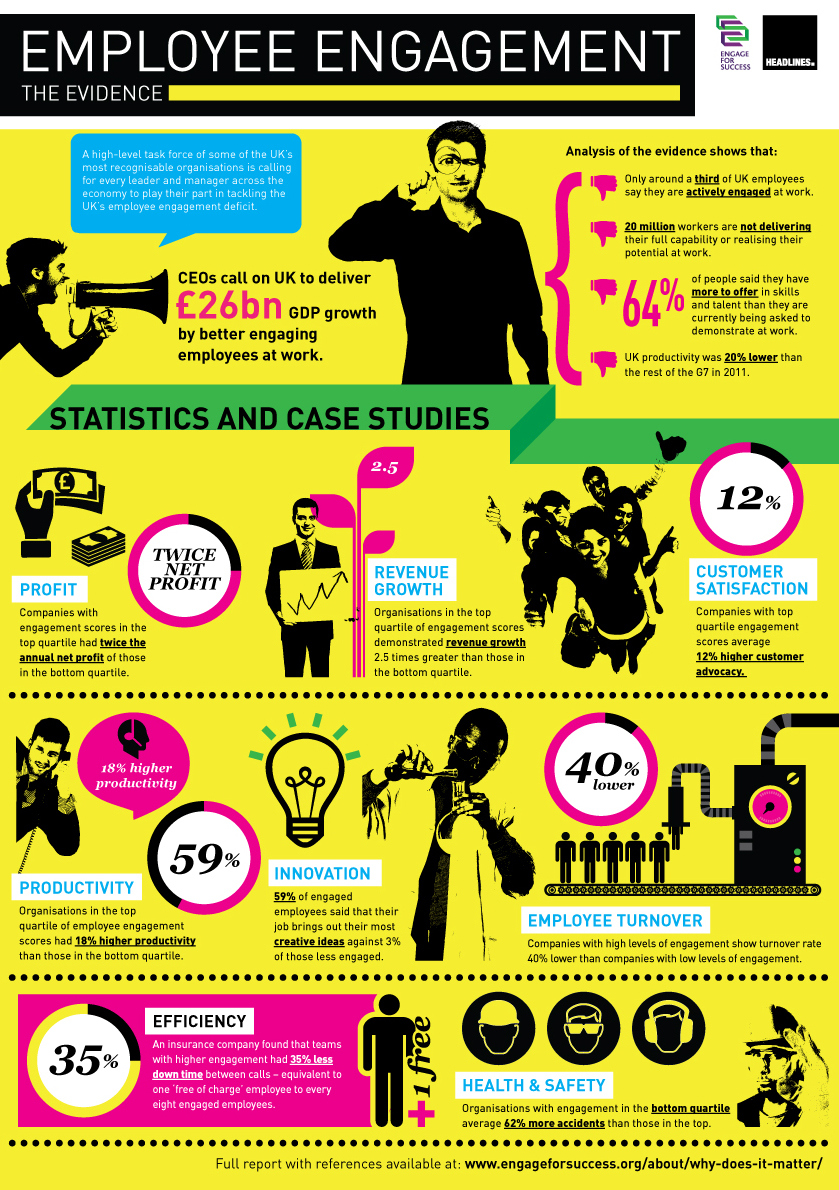
This week I attended a series of talks on the subject of employee engagement, organised by Engage for Success North West.  It got me thinking about the general topic of engagement, and some of things I have tried or would like to try.  Hence this blog post.

If you've not heard of Engage for Success then I'd recommend you visit their website, and in particular check out the Infographic below, from their site, which summarises everything you need to know about why engagement is important to business.


There's been a lot written about employee engagement as a concept.  Lots of more talented bloggers than I have given their views, and I'll try to reference some here.  For a good critique of the concept then I'd recommend you read this by Rob Briner.

But for now let's pretend we all agree employee engagement is a good thing and there's evidence to support it.

I was going to abbreviate employee engagment to EE but then I've had "dealings" with that company over the years and they are most definitely NOT a good thing, at least as far as customer service goes in my experience.  So no abbreviations please.

The E4S (sorry, I can't even stick to my own rules) event had some good presentations from The Co-operative Group, United Utilities and ACAS (the excellent Peter Monaghan again).  The slides have been made available by E4S and if you want the detail you can get it there, but in particular the talk from Louise Beardmore from United Utilities got me thinking.

She talked about the employee experience influencing (possibly creating) the customer experience.  United Utilities are subscribers to this school of thought, and they're not alone.  Both Netflix and Virgin Group have received headlines about their approach to this in recent times.

There's also stuff published online about this, both in the article here and by Gemma Reucroft in her blog.  So its not a new concept, but why do so many organisations struggle with it?

If customers give an organisation what it needs (usually, but not always, money, but at the very least a continued demand for its products and/or services), and so much of what differentiates an organisation from its competitors is the intangible skills and knowledge of its employees who win new customers, ensure repeat custom and do their utmost to impress existing ones - then organisations would be foolish to ignore the employee experience as being at the heart of this.

I often compare the relationship one has with ones' employer to the relationship one has with a partner.  In fact I'll blog more about that in a future post, but for now let's imagine you're out socially and get asked if you have a partner and what are they like.  If your relationship with them is strong, you'll respond positively.  If you're going through a bad patch, you might give a very non-committal answer.  If things are genuinely poor, you might even have a moan about them.  Either way, the person you're speaking to is going to get an instant impression about your partner that will be difficult for them to shake.  They would also get an instant impression about how your partner must treat you in order for you to feel that way about your partner.  Some of these impressions may be inaccurate, but some will be very accurate and it would affect that persons' view of your partner and your relationship.

Its the same with employers.  If you're enjoying work and are treated well, you'll tell people when asked about your work.  The opposite is also true.

But look at how some organisations literally jump all over social media for customers - I've lost track of the times I have tweeted an organisation and had pretty much an instant response via Twitter, and some hours later got a total and satisfactory resolution to my problem.  That's a great customer experience, but do organisations jump all over the slightest grumble or complaint from employees in the same way?

I'm not sure they do.  But they should.

United Utilities mentioned having data on employees and their interactions and wants.  I think this is a good idea and is something I've mentioned to organisations I've worked with in the past.

If an organisation can collect stacks of data about its customers and use this in some CRM style interface / system, and tailor services and products around what that customer has said, done and tweeted - then the same ought to be possible, and desirable, for employees.  
Obviously you'd have to have a sufficient number of employees if you wanted a technical solution to this, but even with a small number of employees it ought to be possible in a more informal way.

For example most HR systems I've seen store a lot of data about employees - personal details, L&D record, leave records etc.  All of this data is relatively static, and although used for statistical purposes I haven't seen many systems, or organisations, who actively use this data to segment employees and map the employee journey in the same way they would a customer group.  And I haven't seen many HR systems that have a record of EVERY employee interaction with the organisation and that tailor services and the employee experience based on these.

Look at how Facebook has tailored adverts based on things you've clicked on.  Its like witchcraft sometimes, but the technology is there.  My entire online experience is usually tailored based on my past habits (careful...not THOSE habits).

So I think organisations could unlock a greater amount of employee engagement by focusing on the employee experience, and tailoring that to the individual employee.

Taking this line of thought further, in this scenario your line managers are your equivalent of the Twitter Customer Service teams, jumping on any employee interaction and resolving it.  And your employees are your sales team, actively selling the organisation and its products/services to customers.

Many organisations are experiencing rapid and often large-scale change.  It can be difficult to maintain employee engagement when going through change.  Perhaps if organisations looked a bit more at the employee experience, engagement might take care of itself - both for employees and for customers.

Till next time.

Gary

PS in other news, some VERY exciting news due imminently about the impact this blog has had and where its going in the future...watch this space!

Friday, 11 September 2015

Sex

I thought that might get your attention.

It hopefully won't have escaped your attention that there has been somewhat of a media storm in the last few days about someone using LinkedIn in perhaps the way its creators didn't intend.

If you don't know what I'm on about, read THIS, to save me summarising what seems to have happened.

And then all hell has broken loose, with as many people criticising the victim as the perpetrator.

Frankly, its got a bit out of proportion now.

Look at THIS article from The Telegraph which outlines how the storm has since developed, and which highlights further unsavoury developments on both sides.

And then The Daily Mail, often considered a bastion of common sense and objectivity, entered the fray with THIS article in order to pour more oil on the burning fire.

What this tells me is that NOTHING, absolutely nothing, is safe or considered a no-go area by the media chasing a story.  The Mail article goes back ten years into the woman's past to dig up stories about parking tickets in order to justify their angle on her.  And various people have accessed Facebook comments that both parties have made about other people - presumably on private accounts.

If you haven't Googled yourself recently, I'd suggest you do.  And not just the first page either, or the second, get through pages 1-10 and see what's out there.  And then do pages 11-20.  And you're still not truly safe, because a reporter would find more.

Anyway, what about the use of LinkedIn to pass on compliments to another person?

Now, I realise I used my last blog to talk about gender imbalance in HR.  So apologies if this touches a little on the same area.

But sex sells.  Or sells newspapers at least.

The perpetrator in the LinkedIn storm says that he was merely passing on positive comments about the professional and well-photographed nature of the victim's profile picture as opposed to the poorly photographed ones presented by others, presumably.

That sound you hear is the sound of straws being clutched at.

I think the man sent the woman a compliment because he liked her picture, fancied her even.

But does that make it right?

Certainly there's enough people defending him, saying that he meant it in good faith. But it strikes me that he was trying to use LinkedIn like a dating site.  That's not to take either side, that's just how it looks to me.

As pointed out in some of the media articles, there are dating sites for professionals.  There are dating sites for non-professionals too, and I've experience of both during my phase as @Single_Man_75 and in my previous blog.  Tinder, POF, Match.com, and the more professional sites - I tried them all in that phase.  I wrote a blog about it twice a week for 18 months that was read by 4,000 people at one point.

But never did I think to use LinkedIn for that type of thing.  Twitter and Facebook, yes, but not LinkedIn. There's got to be a line.

And yet...and yet...I've had it done to me via LinkedIn.  Once someone tracked me down via LinkedIn (the only way I could be easily found apparently) to ask me out - and we did go out, but that's all I will say as that's a very sensitive (and explosive) story.  And very very recently I met someone for coffee whose opening line was "you've got a lovely profile picture on LinkedIn".

Now, isn't the latter more or less what the perpetrator did on LinkedIn this week?

I was a bit flustered because I hadn't expected it.  My profile picture is a professional one done by The Headshot Guy (freebie at a conference), which I think is a good one considering, well, you know, but never did I think someone would pay me a compliment over it.

And when they did, my reaction was initially confusion, and then vague embarrassment.  I didn't think to do what this weeks' victim did.

But if I had, I might have had the media attention myself, just a few days earlier.

I think my experience shows that the case this week isn't an isolated one.  Again though that's not to suggest its right, and maybe the victim was doing society a favour by highlighting that it does go on in the hope that making it visible stops it.

But sex does sell, so maybe an attractive profile picture does garner more views.  I don't get many on LinkedIn, and views seem to be split 50/50 men to women, but then maybe I appeal to both sexes.  Now and again I will post a picture of myself in my tight lycra trisuit on Twitter, no-one comments though but who knows what they do in the privacy of their own house?

So where does this leave us?

I think people will use LinkedIn as a substitute dating site, though I don't condone this.  Hopefully this weeks' story will prevent it happening again, because to upset people in doing so isn't good.  And as we all know in HR, its the perception of the comment, not the intention, that matters.

And you'd think a lawyer would know that better than most.

I'll leave you with the thought that there are plenty of people who would love to be paid a compliment, and would welcome it too, but who just don't get any.  You never know when you've received your last compliment, so my view is to treasure them when they do come.

Just stay on the right side of the line.

Till next time.

Gary

PS in other news, a busy period for me triathlon-wise as I've got 3 races in 21 days.  I may be tired at the end of that...

Sunday, 30 August 2015

The only man in the village

Recently I've been reflecting on being part of a minority group - men in the HR profession. I thought I'd spend this blog sharing my observations about this and what impact it has, if any. 

Read on...

I've encountered it all over the place so it's definitely a thing. But it's taken other people pointing it out recently to make me dwell upon it. 

In my current role and organisation I'm the only man in an HR section of 18. In my previous two organisations out of a total of around 30 different HR professionals in two companies I was one of only three men across both. In my work delivering CIPD qualifications for six years, I taught around 120 students and can recall only five male students. When I was a CIPD student myself I was the only man on the course for each year I studied.

I go to conferences and networking events and the audience and attendees are predominantly female. 

The CIPD once said that 72% of their members are female. In another bit of teaching I do, student numbers are almost exclusively female too and it's estimated that over 80% of new entrants to the HR profession are female. 

And there's lots of other statistical evidence on the subject too.

But do I mind?

I might well be in a minority group but I don't feel neglected, disregarded, discriminated against or otherwise excluded, for the majority of the time anyway. It doesn't bother me much. Once I did joke that I was the token male and felt like some kind of positive action role model, but that was in jest. It did make me think though about why women outnumber men so much in our profession?

I put a lot of stock by Allen and Barbara Pease' research on the differences between men and women. Although delivered HERE in a very light hearted way, there's a considerable body of research behind it and some relevant truths to explore too. He doesn't mention HR in this when he talks about professions and occupations with high gender imbalance, but the principles are the same - you can see lots of HR work being perceived in the same way as Counselling, which he does mention - as a fluffy, talking profession where you listen to lots of people complaining. 

I generalise, of course, and am just extending Pease' anecdote. But is this why the HR profession attracts more women than it does men? There's certainly not much of the geo-spatial and logistical co ordination Pease asserts attracts more men. Though there IS a lot of problem solving. 

What do you think?

Interestingly though when you look at the top levels of the HR profession, the numbers are a lot more equally divided. This suggests that whatever barriers there may be to men entering the profession, there are not as many preventing men from succeeding and advancing in the profession once they have entered it. Or does it suggest that the further away from the front line of HR you get, the less those types of roles are likely to be attractive to women? Again, just referencing Pease' line of thinking here. 

Pease also suggests that there is something about how the brains of gay men work that enables better relationships to be forged with women, and to share some of the same characteristics in terms of skills at certain jobs and attributes to succeed in them. Although this is another generalisation, there is some relevance to HR as a profession where there does seem to be a higher proportion of gay men than in some other professions. Indeed, of the various men I have referenced in my introduction above as having been part of my peer groups, around half have been gay, and it's often been the case that people have assumed that I myself am gay simply because I'm a man working in HR. Again, this doesn't bother me at all, but it's interesting how stereotypes start to develop. 

Hence the title of this blog, a reference to the Little Britain character Daffyd and for a good illustration of this, this sketch in particular. It's how I sometimes feel when I encounter another man in my HR team. 

A while back a team I was in were looking to arrange an Awayday that included a fun element and various options were presented for the team to choose from. The menu of choices included some things that were definitely aimed towards the female dominated team, though that's not to say that I might not have enjoyed them too or that some of the women may have disliked them, just that it would have been outside my comfort zone and there were no activities that catered exclusively for the male minority - and perhaps that's entirely right, after all I'm a minority of one and it's difficult to cater for all. 

On a recent training course there was just me and one other man in a group of 13 trainees, and at one stage the trainer made reference to this in order to make a point. I didn't mind, and the trainer herself admitted she was taking a risk by raising the point, but it again highlighted how obvious it must be to those looking at the HR profession from outside it. 

Interestingly though, with equal pay increasingly in the limelight and seemingly due to expand its legislative range soon, this article suggests that men in HR tend to receive higher salaries than women - which can't be a situation anyone in the profession is proud of. 

Earlier this year, David Jackson (who you should all be following on Twitter) wrote about it in his own blog, from which I've taken some inspiration.

We aren't the only profession with such a gender imbalance though. For the reverse situation, see IT in this article.

In David's blog he poses the question should we be bothered by the statistical imbalance?

That's a good question but I'm inclined to say no. Until someone can prove that HR needs more men in order to be more effective, and IT needs more women in order to be more effective, I can't see a compelling case for doing anything at all.  Yes, there are minority groups and I'm one of them. But it's not doing any harm, or preventing anything from happening, as far as I can see at least. 

It's just a statistical phenomenon. 


Its not causing me any problems.  And I haven't heard any other man complaining either.

If I'm the only man in the village, so be it. 


What do you think?

Till next time...

Gary

PS in other news, wedding invites now issued and it's just one year till the big day! Oh, and Poppy FINALLY slept through the night for the first time in ten months!